New Project: Metageographies and Spatial Frames: Coastal Management as Situated Practice in the international Wadden Sea Region

Following a successful application for funding from the German Research Foundation (DFG), my funding is secured for three years of research on embedded spatialities and situated practices of coastal management in the Trilateral Wadden Sea Region. The project will commence in Autumn 2016.

A summary is provided below. The project represents a continuation of a my recent exploratory work at the Wadden Sea (reported here & here) and more broadly on cultural geographies of the coast. At a conceptual level there are strong continuities with my previous research on metageographies and to a lesser degree, soft spaces, in spatial planning.
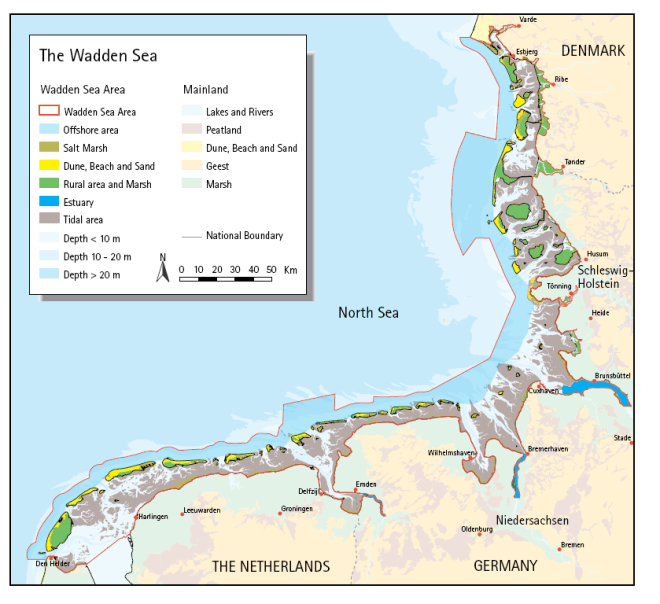
Wadden Sea

Coastal management constitutes an ever-present and challenging task for coastal communities across the world. Coastal landscapes occupying the interface between land and sea are characterised by particular and evolving relations between society and nature and characterised by complex interactions between geophysical, ecological, economic and socio-cultural processes. They are imbued with cultural and natural values and associated with diverse and at times contested rationalities of coastal and nature protection. Theoretically informed understanding of the relationships between coastal communities and their environments remains limited. In particular, there is an evident need for situated perspectives which explicitly recognise the diversity of coastal places and associated embedded practices of coastal management.

This research project introduces a novel, innovative approach to addressing the spatial dimensions of coastal management and the implications of particular spatialities on coastal management practices. Taking seriously the proposition that coexisting heterogeneity, multiplicity and diversity is a constitutive feature of spatiality, the project will firstly examine the extent to which coastal management practices are regionally embedded and situated within the coastal landscape. Through comparative case study analysis the research will identify similarities and dissimilarities in coastal management practices across the Wadden Sea and assess the extent to which dissimilarities are associated with local and regionally-specific cultures of practice and landscape characteristics. Secondly, recognising the socially constructed nature of space as well as the structuring role of spatialities in social relations the research will examine the role of embedded spatialities in the collective construction of coastal landscapes and practices of coastal management.

Two comparative cross-border case studies, located at the Dutch-German and Danish-German borders constitute the empirical focus of the research. The project will (a) identify the principal SIS of coastal management within each case study area and their associated actor constellations, normative principles and cultures of practice; (b) identify the influence of material spatial practices on the social construction of the Wadden Sea coastal landscape; (c) examine the role of metageographies as powerful spatial structures underlying the institutional structuring of coastal landscapes and coastal management practices; (d) identify, classify and critically examine processes of spatial framing and resultant spatial frames and their roles within the discursive context of specific sectoral-institutional systems; (e) examine the extent to which the spatial separation of nature and culture in discursive and material structures influences the conceptual separation of nature and culture within the wider institutional contexts of coastal management and nature protection.

Cities and Regions in Cross-Border Cooperation: Competing or Complementary Dynamics?

On 17th May, I convened and chaired a session on cities and regions in cross-border cooperation at the Border Regions in Transition (BRIT) annual conference. The conference took place in Hamburg (Germany) and (Sonderborg) two hundred kilometres to the North and across the border in Denmark. The conference was jointly hosted by the University of Southern Denmark (Centre for Border Region Studies), HafenCity University Hamburg and University of Hamburg. The theme of the conference: Cities, States and Borders: from the Local to the Border placed emphasis on the evolving roles of cities in relation to nation-states and their territorial borders in the context of economic globalisation and securitisation.

Against this background, the session on cities and regions in cross-border cooperation sought to explicitly address the dynamics of cross-border regionalism and city-regionalism through critical reflection on empirical case studies located across Europe. It is evident that European cities and regions can and do benefit through cooperation across nation-state borders and the realisation of the development potentials of cross-border functional regions. The well-known cases of Öresund, Basel Metropolitan Area, Lille, Luxembourg and Geneva demonstrate clearly that territorial borders need not present insurmountable obstacles to metropolitan regional development (Sohn et al. 2009, Hansen 2013, Fricke 2015). In cross-border metropolitan regions, governance capacity is matched by functional integration and a comparatively high density of cross-border economic, social and cultural relations. Cross-border contexts characterised by asymmetrical spatial development structures face more significant challenges in the establishment of mutually beneficial cooperation initiatives (Calzada 2015). Indeed, as cross-border cooperation in Europe matures, it is increasingly apparent that cities and regions tend to follow distinct strategies and as a consequence multiple partnership initiatives often emerge within the context of larger cross-border regions. As connectivity between cities and metropolitan regions increases, neighbouring rural hinterland regions may face a relative loss of connectivity and become further marginalised. Relational processes of metropolitanisation and peripheralisation are shaped by the spatially selective opening of borders and the associated construction of cross-border corridors and gateways.

May own paper within this session concerned the emerging Fehmarnbelt region at the border between northern Germany and southern Denmark and the role of the cities of Hamburg and Copenhagen and their respective metropolitan regions in this context.

Coastal landscapes as Boundary Spaces: Wadden Sea Dykes and the Materiality of Coastal Places

In January, I presented a paper at the fourteenth New Cultural Geographies Conference, hosted this year by the Karl-Franz University, Graz, Austria. The abstract is reproduced below. The paper sought to engage with recent debates on the place materiality, following the cultural turn in human geography.

Abstract:

Coastal land- and seascapes constitute liminal, boundary spaces, occupying fluid zones of transition, between the land and the sea (Leyshon 2015). Despite a long history of fixing coastlines on maps and charts, the boundary between the land and the sea defies precise measurement and is characterised by rhythms of change across multiple time-scales. In the context of global climate change, coasts are increasingly recognised to be vulnerable places facing uncertain futures. Understanding coastal places requires appreciation of the powerful material presence of the physical land and seascape and its influence on daily rhythms, local weather patterns and everyday spatial practices. Coastal places moreover are frequently characterised by historical narratives of struggle against the sea, histories of the loss of land and its retaking through material spatial practices of dyking and land reclamation. Recognition of the particularity of coastal landscapes has led to historical and contemporary studies of coastal identity and place attachment among coastal communities (e.g. Fischer, N. 2007, Fischer, L. 2011, Ratter & Gee 2012). Recent contributions by McKinnon and Brennan (2012) and Gee (2015) among others, step across the boundary from the land to the sea providing new insights into the individual perception and social construction of places at the sea. In this context, place attachment to individual seascapes is understood to be influenced by the full range of sensory perceptions and emotional associations, including particular sounds, smells, and memories in addition to visual aspects (Gee 2015). Conceptually, the physical materiality of coastal places provides a counterpoint to contemporary constructivist and poststructural readings of space as relational, socially constructed and cosmopolitan (c.f. Massey 2009, Tomaney 2012). Attention to coastal places highlights the constraints set on the production of place imposed by the immediate physical environment and the need for accounts of the social construction of place to be grounded in the topography of the material landscape (Dirlik 2001, 22). Attention to coastal places furthermore invites a reconsideration of the influence of spatial boundaries and boundary features in the landscape in the structuring of place and space. The paper traces the role of dykes as materially and symbolically powerful boundary features of the Wadden Sea coastal landscape. The role of dykes in the material and conceptual separation of nature and culture into distinct domains is explored with reference to historical studies and contemporary policy debates on coastal and nature protection at the German Wadden Sea coast. It is argued that dykes, as material spatial structures have a profound influence on the structuring of the coastal landscape. Dykes as boundary lines of spatial separation, are instrumental in the socio-cultural separation of nature and culture into natural and cultural landscapes at the Wadden Sea coast. Material and institutional path-dependencies furthermore ensure the endurance of a particular paradigm of coastal protection, founded on the concept of a continuous fixed and uninterrupted, dyke-protected coastline.