Environmental Policy as a Driver of Spatial Thinking?

A blogpost for The Regional Studies Blog

Researchers and practitioners in the field of regional studies have long promoted spatial approaches to policy, development and the application of public sector resources. In Europe, concepts such as territorial cohesion, place-based approaches and integrated spatial planning all promote spatial sensitivity in policy-making and are critical of the ‘spatial blindness’ of approaches which do not explicitly take the spatial dimension into account. Within the European context, spatial approaches to policy are concerned with spatial inequalities, the spatial impacts of sectoral policies and regional diversity. A central concern is how to work with deal with processes which cross the political and administrative boundaries of nation-states, whether at international or sub-national levels. How do policy-makers deal with functional regions which cross the borders of two or more administrative territories?
Recently, however environmental policy has become a significant driver of spatial thinking in Europe and elsewhere (see recent reports from the European Environment Agency). Through the requirements of Strategic Environmental Assessment for example, policy-makers and practitioners are required to consider the ‘upstream’ and ‘downstream’ environmental impacts of intended projects and policy measures. It is perhaps within the area of water resource management, however that the adoption of spatial approaches is most advanced. The EU Water Framework Directive introduced in 2000 requires the river basin to be adopted as the principal unit of management, regardless of whether the resulting river basin districts cross international, regional or local administrative boundaries. More than ten years later, practitioners are still struggling to adapt to the requirements of the river basin management approach and the need to ‘think outside the box’ which this implies. Nevertheless river basin management is an important, innovative example of a spatial approach in policy and practice which should perhaps receive more attention from the regional studies community.

Spatial Justice and the Crisis of Regional Development Theories

A Blogpost for the Regional Studies Blog
The 2012 Regional Studies Association Early Career Conference took place on 1st and 2nd November at HafenCity University in Hamburg. The conference under the title of Times of Change: Future Directions in Geography, Urban and Regional Studies examined the implications of the current economic and financial crisis for future of regional studies.  Individual sessions covered a wide range of specific topics including finance, innovation, place branding, resilience and sustainability, territorial inequalities and regional governance.
 RSA ECA Conf Hamburg
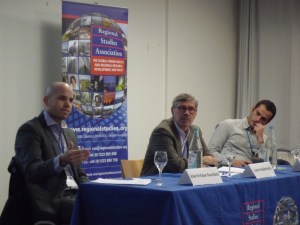
Enrique Garcilazo (OECD) , Costis Hadjimichalis and Pedro Marques, Final Plenary Session, RSA Early Career Conference, Hamburg 2nd November 2012.

The conference ended with a provocative final keynote address from Professor Costis Hadjimichalis (Harokopio University, Athens) who argued for the need to evaluate the contemporary crisis from the perspective of urban and regional studies. He highlighted in particular the underlying geography of spatially uneven capitalist development at the root of the current economic and financial crisis in Europe.  His contribution challenged the conference participants to re-examine the politics of mainstream neoliberal economic theory and its spatial implications. He suggested that we need to ask ourselves if we are satisfied with uneven development and social and spatial injustice.

 Prof. Hadjmichalis further claimed that there is an evident crisis of regional economic theory, as many of the models of the pre-crisis period have been found to be wanting. Significantly, however, he argues that there has been a notable silence from the proponents of such models and as yet, the required re-evaluation and critical re-appraisal has still to occur. For the author of this blog post, his talk provided a very important reminder of the need to constantly critically reflect on the silences within our research and the need to address critical questions of uneven development and social and spatial injustice. His talk was in part based on a recent paperpublished in European Urban and Regional Studies.
The  Early Career Conference was attended by 60 early career researchers (mostly PhD students) from 18 countries. Together with the journal Regional Insights and Early Career Grant Scheme, the early career conference is a key element of the RSA’s strategy to support researchers in the early stages of their careers.  Indeed we hope to see papers based on some of the conference presentations in future issues of Regional Insights. The conference was organised by Dr. Tim Heinemann of HafenCity University, Hamburg and Dr. Pedro Marques of Kiel University.

Crossing the Fehmarnbelt: A New Transnational Region in the Making

A blogpost for The Regional Studies Blog

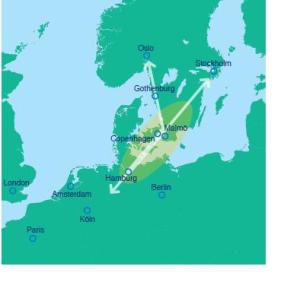
Commencing operation in 2021, a new tunnel will provide the final piece in the jigsaw linking the city of Hamburg in Germany to Copenhagen in Denmark and Malmö in Sweden which together form the STRING region. This fixed link will complement the existing bridge crossing the Öresund strait between Denmark and Sweden which opened to traffic in July 2000.
The Fehmarn link, together with related investments in the connecting road and rail transport networks in both Denmark and Germany is of game-changing significance for the economic geography of Northern Europe bringing Scandinavia another step closer to the centre of Europe. Significant economic benefits are expected at the regional scale as new opportunities for cooperation, trade and tourism emerge. At the local level, however, negative impacts are anticipated as other trade and passenger routes become less competitive and potentially cease operation. The tunnel alone will not bring about economic, social or cultural integration.
 STRING
The Fehmarnbelt Region (courtesy of STRING)
Indeed a wide range of political and economic cooperation initiatives are already actively seeking to build the required ‘mental bridge’ and turn the Fehmarnbelt Region into a reality . The commitment of political, economic and administrative actors was demonstrated in force through a series of events held between 26th and 28th September in Lübeck and Hamburg. The so-called Fehmarnbelt Days included an official dinner where the European Commissioner for Transport was the guest of honour along with senior policy-makers from Germany, Denmark and Sweden.
Other events however had a more public focus with an ‘Idea Factory’ with over 300 participants and many opportunities for networking among businesspeople and development organisations. Perhaps the most important lesson from the Fehmarnbelt Days and the associated cooperation initiatives is that the prospect of the fixed link has already provided the impulse for closer cooperation in economic, cultural and social political spheres which indeed to a large extent does not depend on the tunnel itself.

Irish Water and the EU Water Framework Directive: More than a Question of Water Charges

First posted on Ireland After Nama

Commentary on the recent announcement of the establishment of a national water company, has, perhaps, understandably focussed on the related introduction of household water charges. The significance of the decision to establish Irish Water goes beyond the issue of water charges (which was signalled long in advance of last week’s announcement). Given the minimal level of detail provided by government on the specific remit and function of Irish Water, it is as yet unclear, how precisely its establishment will impact on the management of water resources in Ireland. Nevertheless, government decisions across the spectrum of water policy have been delayed over the past twelve months pending the formal decision on the establishment of a national water company, a decision which was expected in September last year. In particular, the question of adequate governance arrangements and resourcing for the implementation of the Water Framework Directive (WFD) has been put on hold.

recent study by the International Centre for Local and Regional Development (ICLRD) on river basin management and spatial planning in Ireland, North and South, found very significant deficits in relation to current governance arrangements and resourcing for  WFD implementation. The study furthermore outlined three ‘strategic options’ for WFD implementation, each involving different institutional arrangements. These strategic options which include reference to the (expected) establishment of Irish Water are reproduced below:

A. Establish the implementation of River Basin Management Plans (RBMPs) as a function of regional government

Allocating responsibilities to Regional Authorities would establish a clear linkage between river basin management and strategic spatial planning. It would also allow for a significant concentration of resources and expertise at the regional scale and thus development of the required critical mass for effective action, which is not currently available at the level of local authorities. The spatial mismatch between the boundaries of Regions (NUTS III) and River Basin Districts would, however, require a high degree of close cooperation among Regional Authorities. Regional Authorities would also need to act in close cooperation with the water management and spatial planning sections of local authorities, as well as coordinating with sectoral agencies and stakeholders. Imposing an additional layer in an already cluttered and complex governance landscape brings inherent risks which would have to be carefully managed.

B. Centralise implementation responsibility under a new National Water Company/Agency

The current Fine Gael / Labour Programme for Government, includes proposals for the establishment of a National Water Company, provisionally known as ‘Irish Water’.  This is likely to be a semi-public agency that will sit alongside the Office of Public Works (OPW), EPA and others.  This organisation could be established with a clear remit in relation to RBMP implementation from the outset. The recently published report on public sector capital investment indicates that a decision will be made in relation to the establishment of this agency by the end of 2011. It also refers to funding of ‘priority schemes’ in RBMPs under the Water Services Investment Programme (Department of Public Expenditure and Reform, 2011).  An advantage of this model may be a close linkage between river basin management and water treatment and supply policy which may have significant benefits in relation to cost recovery and sharing of resources. Such a model, may, however, favour more traditional ‘hard’ engineering approaches to water quality protection; approaches which the WFD seeks to move away from and are associated with inhibiting the development of integrated cross-sectoral approaches. In particular, a centralised, sector-specific approach of this nature may make the establishment of links with spatial planning more difficult. This model would need to be accompanied by specific measures and additional resources to ensure that that planning decisions are informed by river basin management and water quality concerns.

C. Centralise implementation responsibility under the Environmental Protection Agency 

The Environmental Protection Agency (EPA) has significant technical expertise across the spectrum of ecosystem management, water quality protection and pollution control. The agency already plays a key role in the monitoring of water quality under the WFD. This model has the potential to lead to the development of innovative multi-disciplinary approaches to river basin management drawing on expertise, knowledge and data from across the environmental sciences. The disadvantages associated with a centralised model, outlined above, also apply in this case, however. Fostering stakeholder engagement and public support would require considerable additional resources and the development of skill-sets which are not currently well-developed in a technical organisation such as the EPA. The experience of water resource managers in Berlin-Brandenburg points to the challenges for technical organisations associated with a shift to the more participative form of governance which the WFD requires.

D. Further develop and enhance the lead Local Authority model

The preparation of RBMPs in the Republic of Ireland was led by local authorities with a lead local authority designated for each River Basin District. It is evident that local authorities currently do not have the requisite levels of resources required for implementation. With significant allocation of resources to lead local authorities, this model could, however, prove an effective means of coordinating and delivering implementation objectives. This model would involve limited reorganisation of existing institutional arrangements. The spatial mismatch issue would not arise, provided the lead authorities had the capacity to ensure cooperation from across the local authorities within the River Basin District. In Northern Ireland, the value of stakeholders was recognised from the outset; however, there is still work to be done in the Republic of Ireland to bring local stakeholders within the action programmes – for their value as environmental experts in their own right, and as leaders of community-based action and education projects.

Retaining responsibility for RBMP implementation within local authorities would provide opportunities for greater integration with the planning and development process than might otherwise be the case. This coordination objective would need to be supported with specific funding including enhanced capacity in the area of environmental planning.  It would also be possible to devolve implementation to individual local authorities. Again substantial investment of resources would be required in order for this model to perform effectively. Specific provision would also need to be made for coordination across local authority boundaries to ensure coherence at River Basin District level.   In the medium to long-term, enhanced local autonomy may be instrumental to ensuring community acceptance and indeed ownership of local project-based measures which seek to integrate river basin management, and spatial development objectives.

It is imperative that key issues of environmental responsibility and sustainable resource management are not forgotten in the current focus on water charges and the short-term costs to the taxpayer. The ICLRD report which draws significantly on international case studies of good practice details the extent of the challenges involved in moving towards sustainable water resource management in Ireland. These include the development of expertise in specialist areas of environmental planning as well as the challenges of communicating across disciplinary and sectoral boundaries which should not be underestimated given the integrated approach demanded by the WFD. Above all, however, adequate response to challenges posed by the WFD requires strategic leadership and the allocation of a sufficient level of resources through dedicated budgets.  Each of the strategic options outlined above have both advantages and disadvantages. What is important, now, however, is that decisive action is taken to provide an adequate framework for implementation to prevent further deterioration in the quality of Ireland’s water resources.

Ireland is not Unique: Learning from the Spanish Housing Crisis

First published on Ireland After Nama

Commentary on the current housing crisis in Ireland has placed significant emphasis on what are often perceived as peculiarly Irish problems of clientelism, cronyism, localism and poor regulation leading to the overextension and subsequent collapse of the property market and a massive oversupply of housing. Comparison with the parallel experience of overinflated housing markets and subsequent collapse in Spain may in this context prove insightful.

The bullet-points summary below is adapted from an article in the International Journal of Urban and Regional Research published in December 2010– Garcia, M. (2010) The Breakdown of the Spanish Urban Growth Model: Social and Territorial Effects of the Global Crisis.

  • Europeanisation and globalisation led to an average yearly growth rate of GDP of 3.5% between 1994 and 2007;
  • This period of economic boom was accompanied by a high rate of in-migration, with foreign migrants concentrated in Madrid and along the Mediterranean coast, where the labour market was expanding;
  • EU funds supported the modernisation of transportation infrastructure, improving accessibility across the country and reducing disparities between richer and poorer regions;
  • Population increase due to a 1970s housing boom, coupled with high net in-migration, trends of declining average household size and increased disposable incomes,  contributed to a high demand for housing, particularly owner-occupied housing in suburban locations;
  • The housing boom was fuelled by the unprecedented availability of cheap credit from international markets;
  • Optimism combined with fear of future price increases encouraged housing acquisition and led to a rapid rise in the level of private debt;
  • The rate of housing development exceeded the rate of population growth in many Spanish cities throughout the 2001-2008 period;
  • The housing boom was facilitated by government incentives for both developers and house buyers;
  • Second homes and speculative investments accounted for a very significant proportion of the housing market;
  • A segmented housing market developed strengthening social inequalities with problems of affordability for young aspirant home owners in particular;
  • Local and regional administrations actively made land available for development, irrespective of spatial plans, with a view to increasing the local tax base;
  • The level of oversupply in 2010 amounted to approximately 1 million housing units, 600,000 of which are newly constructed;
  • Levels of unemployment in the construction sector are around 30%;

While there are striking similarities, there are key differences in the response to the crisis by government and the banking sector. In particular, Spanish banks have taken an active role in the property market, selling houses at discounted prices and developed innovative mechanisms to restructure the mortgage debt of households whose employment circumstances have deteriorated.

It would appear that there is significant potential for cross-national learning between Ireland and Spain, both in terms of disentangling local, European and global causal factors (in as much as this is possible or useful) and in terms of coming up with solutions and ways forward. We cannot fully understand post-crisis Ireland without an appreciation of similar experiences elsewhere.