Sustainable Land Management as a Research Priority

The 2013 Status Conference of the German research programme: Sustainable Land Management (Nachhaltiges Landmanagement) took place between 17th and 19th April in Berlin. The ambitious research programme seeks to develop new innovative approaches to address challenges of sustainable land management in Germany, from an integrated, transdisciplinary approach. It is funded to the tune of approximately €100 million by the Research for Sustainable Development programme (FONA) of the Federal Ministry for Education and Research over the period 2010-2015. Although the conference was internal to the research programme participants numbered approximately 500, representing the full range of funded projects, spanning the physical and social sciences as well as practitioner stakeholders, who play a key role in the transdisciplinary research approach.

Perhaps unsurprisingly, the precise meaning of sustainable land management is the subject of significant debate, with multiple disciplinary perspectives and varying stresses on each of the three elements, sustainable, land and management. The objective, however is to develop approaches which are broader than existing practice in the individual disciplines of  land-use planning, property surveying and management, landscape, spatial and environmental planning and directly engage with stakeholder groups.

The research programme itself includes projects based both within Germany and internationally and aims to develop global as well as regional scale perspectives. I was involved, (with Prof. Jörg Knieling, HCU Hamburg) in moderating one session on international perspectives on governance which included papers/presentations from work in Namibia and Brazil as well as northeastern Germany (Session 40 in the official programme here). The international perspectives served to question Eurocentric perspectives concerning ideas of land use and in particular land ownership and highlighted the often complex relationships between customary and statutory legal traditions and practices. The German presentations, brought to light significant contradictions and ‘asymmetries’ in the institutional frameworks governing land-based resource management and protection in Europe. Such asymmetries are found to be particularly pronounced where user groups and stakeholders seek to introduce new sustainable management practices involved closed loop material and energy flows and where ‘use’ and ‘protection’ rationales are combined through multi-functional approaches.

Directly following this session, we delivered an interactive discussion section focussed on the topic of sustainable energy planning at the regional scale, provocatively asking the question of whether energy planning should be considered a task of spatial planning or a form of sectoral planning. A presentation on selected international approaches to sustainable land management (which we are sub-contracted to prepare an ‘expertise’ on) with potential relevance to the question of energy planning provided the key input to the discussion. From this international review it was clear that there are no ‘golden bullets’ and that governance and management approaches need to be developed within the context of the specific region in question, with regard to actor constellations, power relations, knowledge resources and framework conditions set at other scales. Of course this is what the research programme is in a sense trying to achieve with its transdisciplinary integrated approach. It will be very interesting to continue to follow the progress of the research programme and see what lessons are learned regarding both sustainable land management and transdisciplinary approaches to research. At some point it may be fruitful to compare the approach developed here to other experiences of practitioner involvement in applied research programmes, whether within Germany or elsewhere in Europe. Priority 2 projects under ESPON (2007-2013 Programme) come to mind as well as the vast and varied experience amassed under INTERREG to date.
Urban and Regional Strategies: RSA Conference Session

I have been asked to chair one session of three papers at the Regional Studies Association European Conference in May. The session goes under the slightly obtuse title: Shaping and Reshaping Europe 3: Urban and Regional Strategies and Conceptualisations

The papers, (all from English universities) are as follows:

The rise of non-state urban and regional strategies, by  John Harrison, Loughborough University,

Critiquing the contemporary relevance of ‘Assemblages of Power’, by Sarah Ayres, University of Bristol,

Austerity and the new Landscape of Urban Governance, by Gordon MacLeod, Durham University.

Each of the papers are concerned with critical reflections on the politics of contemporary processes of urban and regional strategy-making, and in particular the role of private sector economic actors in processes of collective governance. While Harrison and Ayres focus primarily on new conceptualisations of processes of regional and local governance in the UK, MacLeod takes a broader perspective and makes a plea for a rethinking of established analytical frameworks of urban governance in light of the current experiences of austerity politics in Europe. It promises to be a stimulating, theoretically-rich session with high level of critical debate (provided it is not scheduled for 8:00 am on the final day!).

Update:

Note this session now contains just two papers (by (Harrison and Ayres). It will take place on Tuesday (07/05) at 16:30.

Soft spaces across the Fehmarnbelt: Territorial Re-shaping and Cross-border Region-building

The following abstract was submitted to the Regional Studies Association European Conference: Shape and be Shaped: The Future Dynamics of Regional Development, Tampere, Finland, May 2013:

Soft spaces across the Fehmarnbelt: Territorial Re-shaping and Cross-border Region-building 

This paper examines the role of soft and hard spaces in processes of region-building across the Fehmarn Belt between northern Germany and Denmark. Recent contributions to the spatial planning and new regionalism literatures highlight the role of non-statutory, soft spatialities and unusual geographies in processes of sub-national and transnational regionalisation in Europe. Indeed, the recent promotion of transnational regional spaces in Europe may be interpreted in terms of the emergence of a qualitatively distinct aspirational territoriality based on explicitly European normative objectives and policy aspirations. Territorialist spatial imaginaries, nevertheless, continue to inform the politics underlying processes of soft space strategy-making and governance at multiple scales, potentially undermining their capacity to break of existing state-centric, ‘container space’ metageographies. From a critical perspective, however, transnational soft spaces raise significant accountability and legitimacy issues and highlight the need to reconsider contemporary models of democratic governance and their application in post-national contexts where the traditional, spatial congruence of state, society and economy no longer holds.

According to its promoters, the Fehmarnbelt fixed link, scheduled to be operational from 2021, will provide a critical impulse for cross-border regional development with potential game-changing significance for the economic geography of northern Europe. This expectation and positive interpretation is, however, not shared by all interested parties and critical uncertainties and value judgements regarding environmental costs and the balance between local, regional and European costs and benefits make any objective economic evaluation difficult. At the local level negative impacts are anticipated as other trade and passenger routes become less competitive and potentially cease operation. There are also serious environmental concerns relating to the ecology of the Fehmarnbelt (an important meeting point between the Baltic and North Seas) and the impacts of the proposed transport connections in Northern Germany. Within this context, cross-border cooperation initiatives involving political, administrative and business actors in various constellations are concerned with the development of the ‘mental bridges’ required for the formation of a new cross-border region.

This meta-regional cooperation space, stretching from Hamburg to Copenhagen and Öresund is characterised by a plurality of soft spatial concepts at multiple scales and with variable boundaries, constructed through elements of territorial, scalar, network and place-based geographies. Drawing on the analysis of qualitative interview data and policy documentation, the paper will examine the soft spaces of cross-border cooperation, as one element of a complex spatial governance landscape where territorial and relational, hard and soft forms of space interact in the socio-political construction of the cross-border region at multiple scales. The paper will furthermore critically examine the (post)politics of this transnational regional-building process, and in particular, the pervasive influence of dominant neoliberal discourses of international competitiveness.

The paper is co-authored with Marta Jacuniak-Suda, Frank Othengrafen and Jörg Knieling (all HafenCity University Hamburg) and draws on case study research conducted under the Soft Spaces, Spatial Planning and Territorial Management in Europe research project. It will hopefully be presented under Gateway G: Territorial Politics and Policy, chaired by Gordon Macleod and John Harrison.

Territorial Cohesion and Inter-regional Financial Transfer Payments

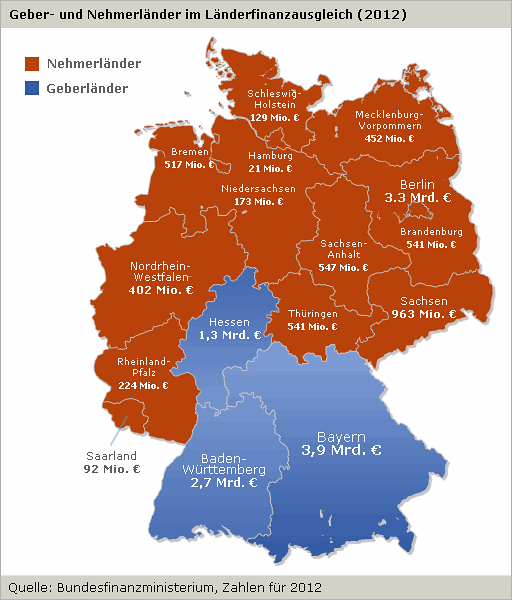
A system of  financial transfer payments is employed in the Federal Republic of Germany as a means of compensating for substantial differences in the financial power of the federal states (Länder). For the year 2012, only three federal states, all located in southern Germany were net contributors while the remaining thirteen states were net recipients of funds under this mechanism. Two of the contributor states (Geberländer), Bavaria and Hessen have announced their intention to mount a consitutional challenge, arguing that the receiving states are not doing enough to cut back on public expenditure. This assertion is of course viewed very critically by the other state governments making it a topic of heated debate.

Länderfinanzausgleich

(source: Mitteldeutscher Rundfunk 5.02.2013, Notes: Federal states shaded ‘red’ are receivers of funds under this mechanism whereas those in blue are contributors. Mio = million, Mrd = thousand million – German Milliarden)

This debate raises issues of inter-regional solidarity and unity -what at the European level is referred to as territorial cohesion. Perhaps, not surprisingly, however, the current debate in Germany does not make reference to the concept of territorial cohesion and employs predominantly simplistic state-centric concepts of spatiality in its discourse. The prime minister of Saxony-Anhalt, however, pointed to the methodological territorialism of the current debate, noting that the simple black/white binary of contributing and receiving states obscured the reality of economic flows, which are substantially influenced by cross-boundary commuting flows (in different words, of course).

There has, been signficant debate and policy development within specific academic and policy communities on the role of spatial policy and planning in contributing to territorial cohesion and the German constitutional principle of equality of living conditions. Here, the concept of supra-regional partnerships of responsibility introduced in 2006 is particularly noteworthy. These large-scale cooperation areas,  each cross the boundaries of a number of federal states and are in part an attempt to identify functional partnership areas of cooperative responsibility or solidarity. Indeed, they may be viewed as counterbalance to the previously dominant focus in German spatial policy on metropolitan regions as the motors for economic growth and regional development. John Harrison and Anna Growe provide a detailed English-language account of these specific elements of federal spatial policy in Germany, focussing on the extent to which they embrace relational concepts of place.

German metropolitan regions and to a lesser extent supra-regional partnerships include some financial measures, often in the form of development funds which can support the development of infrastructure or networking capacity development projects. These measures focussed on cooperative regional development and in effect, territorial cohesion, in recent years have tended to play a secondary role, in comparison with the dominant economic profiling and competitiveness agendas of the metropolitan regions.

It is evident that mainstream debates concerning inter-regional financial statements lack spatial nuance and suffer from (federal)state-centric methodological territorialism.  The concept of territorial cohesion, has influenced federal spatial policy but the link with debates and policies regarding imbalances in the economic strength of German regions and federal states and associated compensatory financial transfers, appears to be missing.

The current proposals regarding the introduction of a planning regulator in Ireland have the potential, as Gavin Daly suggests to insert a much need level of oversight into the Irish planning system which has been missing to date (notwithstanding the signficant role of An Bord Pleanala as a national appeals body). The question of the relationships between the proposed regulator and existing institutional structures are critically important. Perhaps more fundamental, however, are the implications for how we understand the role of local and regional democracy with regard to planning in Ireland. Given past experience, it is perhaps unsurprising that there is a tendency to move a away from a local democratic model of planning to a more hierarchical, technocratic one, but it is important that both the positive and negative aspects of this shift in approach are fully considered. See the comments from Cllr Dermot Lacey on this issue here. The possibility for Regional Authorities to have a role in determining key aspects of spatial strategies at this regional level would seem to me to be worth maintaining and enhancing. A key element here is ensuring buy-in from the local and regional levels of governance. Maybe, an explicit acknowledgment and recognition of the contested and political nature of spatial planning is also needed? It may be helpful to consider the reasons why Northern Ireland is putting in place a major process of reform to decentralise planning powers and competences from the national/regional level to the local level.