Ireland is not Unique: Learning from the Spanish Housing Crisis

First published on Ireland After Nama

Commentary on the current housing crisis in Ireland has placed significant emphasis on what are often perceived as peculiarly Irish problems of clientelism, cronyism, localism and poor regulation leading to the overextension and subsequent collapse of the property market and a massive oversupply of housing. Comparison with the parallel experience of overinflated housing markets and subsequent collapse in Spain may in this context prove insightful.

The bullet-points summary below is adapted from an article in the International Journal of Urban and Regional Research published in December 2010– Garcia, M. (2010) The Breakdown of the Spanish Urban Growth Model: Social and Territorial Effects of the Global Crisis.

  • Europeanisation and globalisation led to an average yearly growth rate of GDP of 3.5% between 1994 and 2007;
  • This period of economic boom was accompanied by a high rate of in-migration, with foreign migrants concentrated in Madrid and along the Mediterranean coast, where the labour market was expanding;
  • EU funds supported the modernisation of transportation infrastructure, improving accessibility across the country and reducing disparities between richer and poorer regions;
  • Population increase due to a 1970s housing boom, coupled with high net in-migration, trends of declining average household size and increased disposable incomes,  contributed to a high demand for housing, particularly owner-occupied housing in suburban locations;
  • The housing boom was fuelled by the unprecedented availability of cheap credit from international markets;
  • Optimism combined with fear of future price increases encouraged housing acquisition and led to a rapid rise in the level of private debt;
  • The rate of housing development exceeded the rate of population growth in many Spanish cities throughout the 2001-2008 period;
  • The housing boom was facilitated by government incentives for both developers and house buyers;
  • Second homes and speculative investments accounted for a very significant proportion of the housing market;
  • A segmented housing market developed strengthening social inequalities with problems of affordability for young aspirant home owners in particular;
  • Local and regional administrations actively made land available for development, irrespective of spatial plans, with a view to increasing the local tax base;
  • The level of oversupply in 2010 amounted to approximately 1 million housing units, 600,000 of which are newly constructed;
  • Levels of unemployment in the construction sector are around 30%;

While there are striking similarities, there are key differences in the response to the crisis by government and the banking sector. In particular, Spanish banks have taken an active role in the property market, selling houses at discounted prices and developed innovative mechanisms to restructure the mortgage debt of households whose employment circumstances have deteriorated.

It would appear that there is significant potential for cross-national learning between Ireland and Spain, both in terms of disentangling local, European and global causal factors (in as much as this is possible or useful) and in terms of coming up with solutions and ways forward. We cannot fully understand post-crisis Ireland without an appreciation of similar experiences elsewhere.

The Territorial Agenda of the European Union

First published on Ireland After Nama

At a time when the financial crisis in the Eurozone is seen to cast doubts on the extent to which European institutions act in the collective interests of Europe, it is perhaps instructive to consider the question of the territorial agenda of the European Union. To what extent does the EU have a coherent spatial policy or agenda or do individual sectoral policies have uncoordinated and even contradictory effects?

This is a question which European spatial policy initiatives have sought to address, particularly since the publication of the European Spatial Development Perspective in 1999.

Yesterday (19th May) at a meeting of the Ministers of EU member states responsible for spatial planning and territorial development in the town of Gödöllő, Hungary a new Territorial Agenda for the European Union was agreed upon. With the title ‘Territorial Agenda of the European Union 2020: Towards an Inclusive, Smart and Sustainable Europe of Diverse Regions’ the document follows on from a previous Territorial Agenda published in 2007. In light of the lead role of the Hungarian Presidency, the new Territorial Agenda has been expected to place a renewed emphasis on reducing disparities between Western and Eastern Europe and the particular development challenges faced by Eastern member states. The document supports the principle of ‘territorial cohesion’ which may be interpreted as balanced regional development at the European level:

We believe that territorial cohesion is a set of principles for harmonious, balanced, efficient, sustainable territorial development. It enables equal opportunities for citizens and enterprises, wherever they are located, to make the most of their territorial potentials. Territorial cohesion reinforces the principle of solidarity to promote convergence between the economies of better-off territories and those whose development is lagging behind.

It is further stated that ‘development opportunities are best tailored to the specificities of an area’ indicating that territory matters and regional development policies need to take account of the specific characteristics and diversity of individual regions. This echoes recent arguments for a ‘place-based’ approach to regional development policy rather than a reliance on ‘spatially-blind’ sectoral approaches (such as the Common Agricultural Policy). Suggesting continued support for an interventionist approach it is noted that ‘Regions might need external support to find their own paths to sustainable development, with particular attention to those lagging behind’.

Drawing on an evidenced-based ‘Territorial State and Perspectives’ background document (as yet not in the public domain) the Territorial Agenda identifies 6 main territorial challenges facing the European Union:

  1.   Increased exposure to globalisation: structural changes after the global economic crisis;
  2.  Challenges of EU integration and the growing interdependences of regions;
  3. Territorially diverse demographic and social challenges, segregation of vulnerable groups;
  4. Climate change and environmental risks: geographically diverse impacts;
  5. Energy challenges come to the fore and threaten regional competitiveness;
  6.  Loss of biodiversity, vulnerable natural, landscape and cultural heritage


Informal meeting of Ministers responsible for territorial development and spatial planning, Gödöllő, 19th May

The challenges outlined serve to highlight that regions in Europe face distinct sets of challenges but that there also significant commonalities. In particular the impacts of demographic and climate change are recognised to vary significantly across the European territory. It may be noted that development disparities between East and West (or urban and rural regions) are not specifically mentioned.

The document subsequently identifies six ‘Territorial Priorities’ for the EU, for the purpose of responding the challenges outlined above:

1. Promote polycentric and balanced territorial development

2. Encouraging integrated development in cities, rural and specific regions

3. Territorial integration in cross-border and transnational functional regions

4. Ensuring global competitiveness of the regions based on strong local economies

5. Improving territorial connectivity for individuals, communities and enterprises

6. Managing and connecting ecological, landscape and cultural values of regions

The concepts of polycentric development and integrated development of urban and rural regions are themes which have featured centrally in European spatial policy since the 1990s; although it may be argued that they still require clarification in terms of their intended operationalisation. The identification of territorial integration in cross-border and transnational functional regions reflects a particular commitment in EU regional development policy to reduce border effects and improve cooperation, particularly through the INTERREG programme from which Ireland has benefited significantly. In total, approximately 40% of the territory of the EU is located within border regions.

Implementation of the Territorial Agenda of the European Union is dependent on EU institutions such as the European Commission taking its messages on board as well as actions by member states, regional and local authorities. The ESPON Programme (see also ESPON Ireland website) receives specific mention in relation to its central role in providing the evidence base for European territorial development and cohesion policy. The new Territorial Agenda places particular emphasis, however, on actions by member states. In Ireland, the National Spatial Strategy and National Development are the principal policy mechanisms in this regard. As the EU does not have any competence in spatial planning, the Territorial Agenda therefore does not represent a binding spatial plan for the EU in any sense. It does however provide a strategic policy framework and represents a high level European commitment to the balanced regional development and place-based approaches to policy. Based on the experience of previous European spatial policy documents such as the European Spatial Development perspective, the impact of the Territorial Agenda may be significant albeit not always directly visible!

Rethinking Planning and Development in Ireland After NAMA

First published on Ireland After Nama

Earlier posts on this blog pointed to the current period of crisis as an opportunity for rethinking accepted ideas, policies and practices in relation to future planning and development in Ireland (for example here and here). The introduction of a new Government with a fresh mandate and (potentially) fresh ideas (see here for a critical perspective!) provides a further opportunity to critically reflect on the role of spatial development policy and practice in the current context.
Understood in its broad sense, spatial planning refers to a state-led interventionist activity that seeks to pursue particular objectives for society through a focus on the diversity and specific qualities of individual places and social and economic relations across space. In contrast to traditional forms of land-use planning, strategic spatial planning claims to provide a focus for the coordination of the spatial impacts of other sectoral policies and public sector investment decision-making processes. In this way the National Spatial Strategy and Regional Planning Guidelines should be expected to inform the proposed new National Development Plan (2012 – 2019) and the decision to progress a new technical university for the Southeast in agreed Programme for Government.

The ‘governance capacity’ of spatial planning strategies is however critically dependent on their capacity to steer the geographical distribution of development and provide a reliable indication of the intensity, quantity and type of development anticipated occurring over the period of the plan. If this capacity is absent then higher level objectives in terms of providing a spatial dimension to sectoral policies will remain aspirational. Unfortunately the record of the past decade indicates that the governance capacity of spatial plans in Ireland, at national, regional and local levels has been rather weak indicating a need to fundamentally rethink some of the basic premises of planning and development thinking in Ireland.

The pointers outlined below are intended as an initial contribution to progressing the debate rethinking planning and development in the current context:

1.    Future planning and development policy and practice needs to make a clear distinction between development in its socioeconomic sense and spatial development. Potential economic benefits in terms of employment generation or commercial rates revenue cannot be the overriding factors in decision-making on spatial development, i.e. the future development of the built and natural environment.

2.    Spatial planning needs to be founded on realistic assessments of projected future growth (or decline) in population, numbers of households, numbers in the labour force and of the economy more generally. Spatial planning decision-making should therefore be needs-based and forward looking, thus reducing the risks of both undersupply and oversupply as we have witnessed recent years.

3.    Spatial planning policy and practice needs to be founded on acceptance that significant areas of the country most likely will not witness significant levels of development or employment creation and may need to plan for continued decline and population loss due to emigration. In this respect, Ireland has much learn from other parts of Europe and in particular parts of eastern Germany, where post-reunification expectations of rapid development have gradually given way to an acceptance of a need to plan for declining population, ‘shrinking cities’ and reduced economic circumstances.

4.    Spatial policy needs to balance normative vision with a pragmatic orientation. The NSS and Regional Planning Guidelines have provided a valuable frame of reference in terms of outlining desirable future spatial development objectives and patterns. The laudable policy goals of balanced regional development and ‘physical consolidation’ of the Dublin metropolitan area need to balanced with an explicit recognition and readjustment of future spatial development prospects in light of the experience of recent development trends. These development trends are well documented and include extensive peri-urban development, ghost estates and a markedly variable performance of Gateway cities.

5.    Spatial strategies should attempt to create a space for shared understanding and agreement among key stakeholders, including political representatives planning professionals, community development and environmental interests. Whether the proposed ‘democratically decided Regional or City Plan’ (Programme for Government, p. 27) with a significantly reduced role for City/County Managers is the best approach to this is of course another question.

Mapping the true extent of Dublin’s functional urban region – What the best available evidence tells us

Originally published on Ireland After Nama

As reported in an editorial in today’s Irish Times, a special issue of the Journal of Irish Urban Studies has just been published, presenting work of the Urban Environment Project, a large-scale, multi-insitutional and multi-disciplinary collaborative research project led by UCD Urban Institute Ireland and funded by the Environment Protection Agency. Issues addressed by the special issue include biodiversity, city-regional governance, office location patterns simulated coastal flood risk and spatial planning. All articles in this issue are available to download here. The analysis below is extracted from one article of this special issue.

The spatial extent of Dublin’s functional urban region or commuting hinterland has served as a key indicator and point of discussion on the ‘sprawl’ of Dublin and extent of uncontrolled urban expansion over the Celtic tiger period. The location of unfinished and partially vacant housing estates in some locations suggests that private developers significantly overestimated the extent of the ‘Dublin market’. The analysis below serves to map the spatial extent of the Dublin functional urban region and identifies the share of the Dublin workforce commuting from the Mid-East Region (Kildare, Meath and Wicklow) and beyond.

The spatial extent of the Dublin Functional Urban Region and Economic Core Area is derived from 2006 Census of Population data. The Place of Work Census of Anonymised Records (POWCAR) subset of the 2006 Census of Population, allows for a direct assessment of employment density at a fine spatial scale and a direct matching of origin and destination data for the analysis of commuting flows. The Dublin Economic Core Area, as shown in Figure 1 comprises all EDs where employment density is at least 7 jobs per hectare (700/km2) within the four Dublin counties.  The ECA includes approximately 406,000 people at work and 525,000 residents in 159 EDs and covers an area of 150.0 square kilometres (km2). In addition to the traditional Commercial Business District (CBD) large suburban nodes including Blanchardstown, Swords, Dublin Airport, Tallaght and Sandyford, indicating the increasingly dispersed and polycentric pattern of employment distribution within the city

Figure 1: Dublin Economic Core Area. Source: Census of Population 2006 POWCAR dataset OSi boundary datasets, OSi permit no. MP009006(c) Government of Ireland

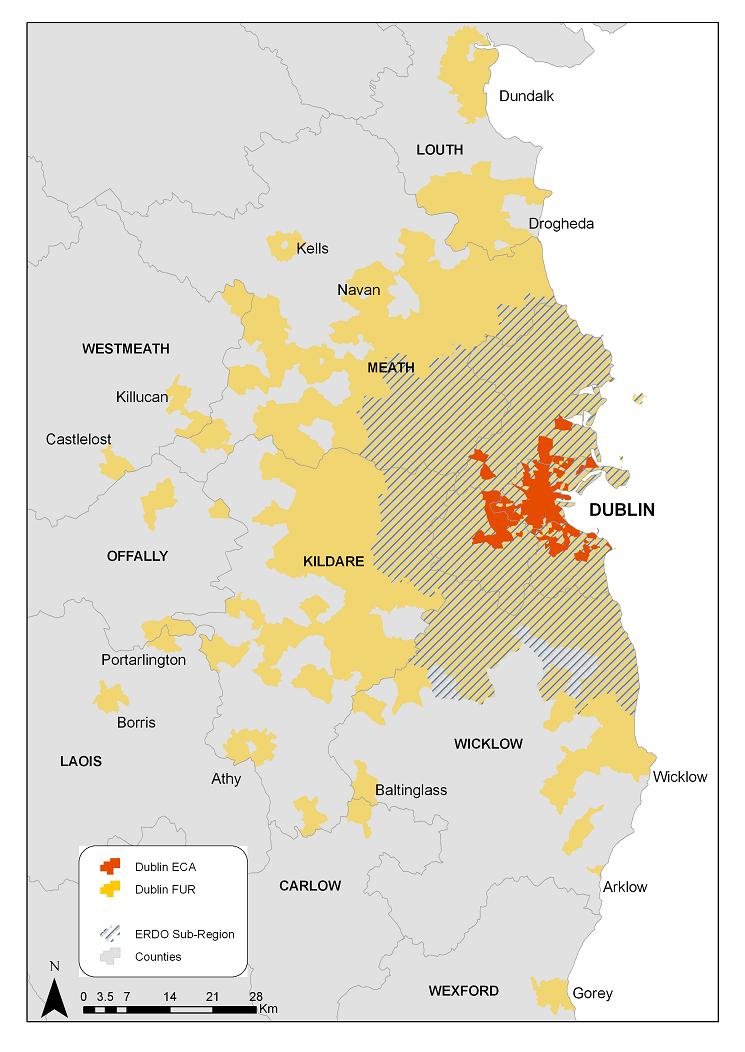
The spatial extent of the Dublin Functional Urban Region (FUR) is subsequently defined in relation to the ECA. The inclusion of EDs within the FUR is determined by two criteria:

  1. At least 10% of workers resident in the ED work in the Dublin ECA
  2. 50 workers, resident in the ED work in the Dublin ECA

The criteria outlined above, are selected to reflect the actual spatial extent of the FUR based on daily commuting flows (Figure 2). In total 454 EDs are included within the 2006 FUR. The total FUR area covers 4,138 km2. For comparative purposes the spatial extent of the Dublin Sub-Region as defined by the ERDO strategy on the basis of 1981 data is shown in Figure 6.12. The area of the Dublin Sub-Region (2,016 km2) is less than half that of the 2006 FUR. Differences in methodology preclude further inferences to be drawn regarding the spatial expansion over the 1981-2006 period. With the exception of Togher, Calary and Altidore, located in north Wicklow, all EDs included in the ERDO sub-region are also included in the 2006 FUR. The principal contiguous area of the 2006 FUR extends to include all of the Dublin Region and large parts of northeast Wicklow, northeast and central Kildare, south and east Meath and southern Louth.  Urban centres located at some distance from the principal contiguous area but included within the FUR include all or parts of Dundalk, Kells, Portarlington, Borris, Athy Baltinglass, Arklow, and Gorey. It should be noted that the spatial extent of the FUR as defined here is less than that defined by Williams et al. in the Society of Chartered Surveyors commissioned study (published in 2007). The FUR has not contracted between 2002 and 2006. Rather, improvements in data availability and methodological changes have allowed for a significantly more accurate assessment of the spatial extent of the Dublin Functional Urban Region. In total approximately 388,000 workers resident in the FUR in 2006 commuted to work in the Dublin ECA. This is however only 52% of the total number of resident workers in the FUR, indicating the continued significance of smaller dispersed centres of employment.

Figure 2: Dublin Functional Urban Region. Source: Census of Population 2006 POWCAR dataset, OSi boundary layers, OSi permit no. MP009006(c) Government of Ireland, ERDO Eastern Regional Settlement Strategy (1985).

A county and regional level analysis of the workforce in the Greater Dublin Area is provided in Tables 1 and 2 below. The Greater Dublin Area workforce (defined by place of work) is composed of workers commuting to a fixed place of work (‘commuters’), those working primarily at home (‘home’ workers) and those with no fixed place of work (mobile’ workers). In this analysis mobile workers are excluded as their principal county of work is unknown. Almost 70,500 mobile workers are recorded with places of residence within the Greater Dublin Area. This compares to a total of 626,162 commuting to work in the GDA and 25,968 working from home in the GDA.

The statistics in Table 6.2 include both commuters and home workers. The place of work of home workers is determined by their place of residence. The total number of jobs in the Dublin Region (525,204) was significantly higher than in the Mid-East Region (126,886) in 2006. Comparing with total population figures, however, provides a more meaningful basis for comparing the regional distribution of employment. There were approximately 442 jobs per 1000 population in the Dublin Region, compared with 267 jobs per 1000 population in the Mid-East Region.

Table 1: Greater Dublin Area workforce classified by place of work and place of residence, 2006, Source: Census of Population 2006 POWCAR dataset

In total 82.6% of those at work in the Dublin Region were resident within the Dublin Region[1]. An additional 13.4% are recorded as commuting from the neighbouring Mid-East Region. By comparison 77.6% of those at work within the Mid-East Region were resident within the Mid-East Region. 11.4% of those at work in the Mid-East Region commuted from beyond the Greater Dublin Area, a significantly higher proportion than for the Dublin Region. In total 35,845 workers are recorded as commuting from beyond to the GDA to places of work within the GDA. This figure, however, represents only 5.5% of the total workforce in the GDA.

Region of residence of GDA workforce, 2006 Data Source: Census of Population 2006, POWCAR dataset

Williams, B. Walsh, C. & Boyle, I. (2010) The Functional Urban Region of Dublin: Implications for Regional Development Markets and Planning, Journal of Irish Urban Studies, vo. 7-9, p. 5-30.

Please reference the published version!

Note: the research was conducted as part of the Urban Environment Project, hosted by UCD Urban Institute Ireland and funded by the Environment Protection Agency. The author’s access to the Census of Population POWCAR dataset was possible by kind permission of the Central Statistics Office.


[1] If mobile workers are assigned to their region of residence, this figure increases to 84.0% for the Dublin Region with a corresponding figure of 81.4% for the Mid-East Region.

Undersupply and Oversupply in the Irish Housing Market: A Closer Look at the Greater Dublin Area

Originally Published on Ireland After NAMA

The NIRSA Working Paper, A Haunted Landscape’ provides an analysis of the current situation of oversupply in the Irish housing market, focussing in particular on the uneven geography of housing development and so-called ghost estates as a very visible and tangible manifestation of the housing crisis.

Ronan Webster of CB Richard Ellis, speaking at the Irish Planning Institute Autumn Conference last week characterised recent trends in housing development in Ireland in terms of a shift from a perception of undersupply to a perception of oversupply. Indeed the Bacon reports of the late 1990s and much official and academic commentary since have pointed to a situation of very significant undersupply in the Dublin Region in particular. It has been widely argued that the undersupply in the Dublin market has contributed to the displacement of urban-generated residential development to the Mid-East region and further afield in ‘Outer Leinster’ (see Society of Chartered Surveyors Housing Study).  A Haunted Landscape, in the contrast, finds that residential development in Dublin City and Dun Laoghaire Rathdown (and Cork City) was far in excess of demand, while housing in Fingal, Kildare, Meath, Wicklow and South Dublin was ‘in line with demand’.

Clearly different notions of undersupply (and by inference optimum supply) are at play here. From a social equity or planning policy perspective it is evident that there was an undersupply of suitable residential development in Dublin City and Dun Laoghaire Rathdown. This undersupply coupled with highly inflated and unaffordable prices inevitably contributed to the displacement of housing development beyond the boundaries of the Dublin metropolitan area. The characterisation of the housing situation in Dublin as one of oversupply betrays the influence of reductionist economics thinking but also reflects a spatial blindness. Housing supply in Dublin and Dun Laoghaire Rathdown cannot be understood in isolation from the analysis of housing supply in the Mid-East Region and wider Dublin housing and commuter catchment areas.  The high demand for housing in the Mid-East Region and associated unprecedented pace and scale of development over the housing boom period may in large part be understood as the consequence of the undersupply of appropriate (i.e. family friendly and affordable) housing in the Dublin Region. Planning policy as articulated at national, regional and local scales in fact strongly supported the concentration of residential development within the Metropolitan Area of Dublin and the designated development centres in the surrounding hinterland area (see map below). It is the failure of the State (central and local government) to provide the necessary infrastructure, services and regulation to support socially sustainable residential development within the Dublin Region that has led to the perverse situation of reported oversupply in the Dublin City and Dun Laoghaire Rathdown and supply in line with demand in neighbouring Hinterland counties. In order to fully understand the social, economic and political geography of Ireland After NAMA, we need to move away from interpretations of statistical data which serve to reinforce the fallacies of methodological territorialism (see Neil Brenner – New State Spaces…), where counties and other administrative units are understood as distinct spatial entities.

Constructing a geography of flows and functional relationships creates challenges in terms of data gathering and analysis but must be seen as a neccessary step in highlighting the evident deficits in dominant aspatial and terrritorial interpretations.


Regional Planning Guidelines for the Greater Dublin Area (2004) Settlement Strategy